

Silence Is Not Stealth
The Physics of Sound, Electromagnetic Energy, and Battlefield Detection

One of the more common things I’ve heard during field training over the years is:
“We need to be quiet so the OPFOR can’t hear us.”
The logic makes sense. We have all seen the movies depicting World War II and Vietnam where the sound of a broken branch, a voice, or movement through the terrain decides a Soldier’s fate. For thousands of years, armies have learned that noise creates vulnerability. A formation that moves loudly or communicates unnecessarily gives the enemy information.
The challenge is that the modern adversary is not limited to what humans can hear. They are measuring a lot more and gathering a ton more data.
The battlefield has evolved from a contest of human senses to a contest of sensors. Acoustic signatures still matter, but modern systems are capable of detecting, locating, and analyzing energy that exists far beyond the human ear.
The challenge for today’s Soldier is understanding that silence and stealth are not the same thing. Reducing what humans can hear does is a small part of reducing what sensors can detect.
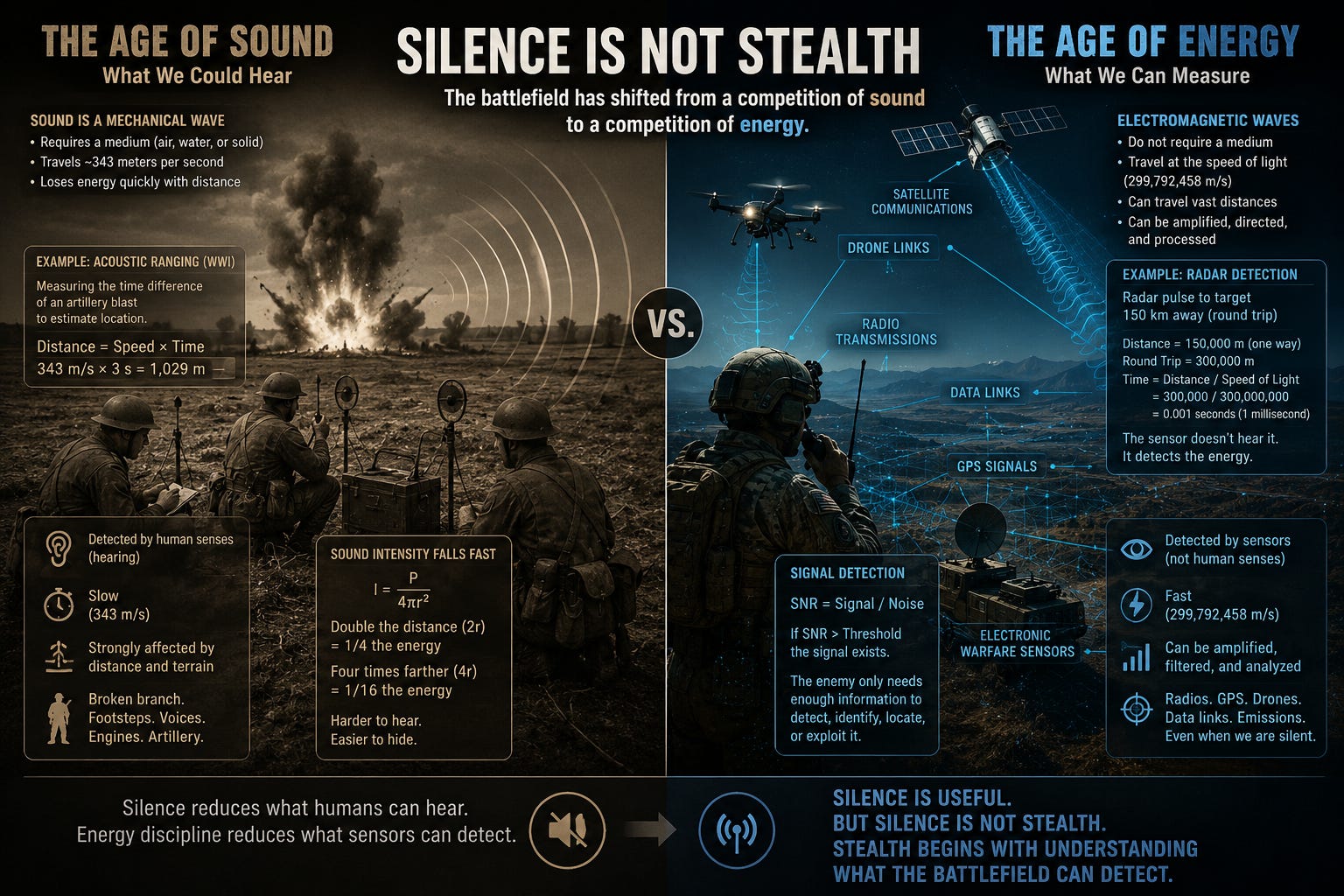
The Battlefield Was Once an Acoustic Problem
For most of military history, detection depended on human senses. Armies listened for approaching formations. Scouts observed movement. Drums and horns communicated across distances. The sounds of marching feet, cavalry, engines, and artillery provided critical information.
Sound was a battlefield signature.
During World War I, armies began using sound itself as a method of detection. Acoustic ranging systems used networks of microphones to locate enemy artillery by measuring the difference in time between when each sensor heard the explosion.
The physics was straightforward: Distance = Speed × Time
Sound travels through air at approximately:
343 meters per second
If one microphone hears an artillery blast three seconds before another:
343 m/s × 3 seconds = 1,029 meters
The difference in arrival time creates a location estimate. This was useful at the time, and Soldiers at the squad/company level could understand the concept with simple math on the front lines.
Think about how we estimate the distance of a storm. We see the flash of lightning first, then count the seconds until we hear the thunder. The delay tells us how far away the storm is. Tracking by sound does have limitations though.
The Limits of Sound
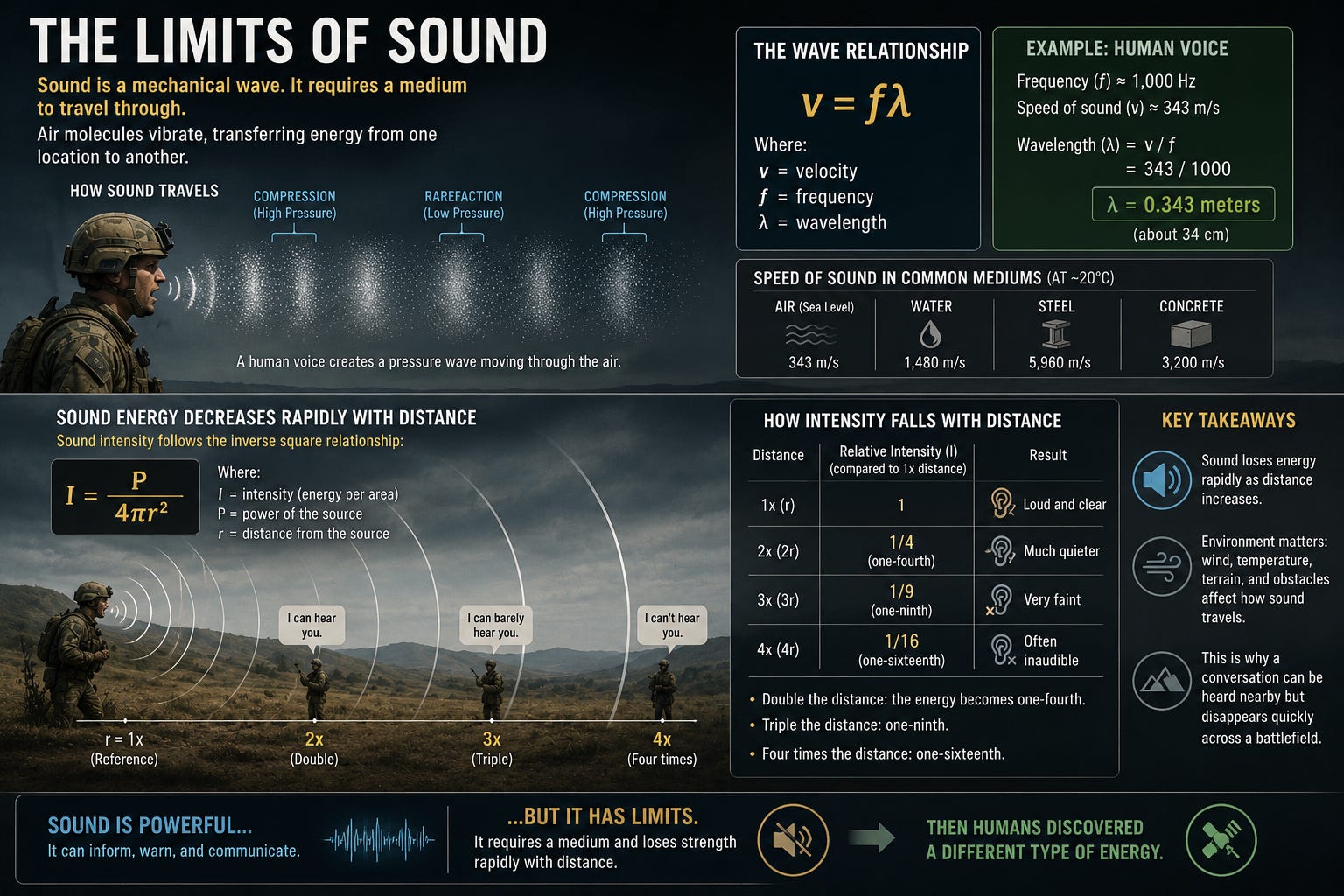
Sound is a mechanical wave. It requires a medium to travel through. Air molecules vibrate, transferring energy from one location to another.
The relationship between frequency, wavelength, and velocity is:
v = fλ
Where v = velocity, f = frequency, and λ = wavelength
For a human voice:
Frequency ≈ 1,000 Hz
Speed of sound:
343 m/s
The wavelength is:
λ = 343 / 1000 or λ = 0.343 meters
In other words, a human voice creates a pressure wave approximately 34 centimeters long traveling through the air.
But this is where sound begins to show its limitation. The information exists if enough energy reaches the listener.
As the wave travels farther from the source, that energy spreads out over an increasing area. The result is a reduction in intensity described by the inverse square relationship:
I = P / 4πr²
Where I = sound intensity, P = power of the source, and r = distance from the source.
The farther the sound travels, the less energy reaches the observer.
Double the distance and the energy becomes one-fourth. Triple the distance and the energy becomes one-ninth. Four times the distance and the energy becomes one-sixteenth.
This is why a conversation can be understood nearby but disappear across a battlefield. The sound has not stopped existing; the energy has spread out until it can no longer be separated from the background environment.
Terrain, wind, temperature, and obstacles create additional challenges. A sound wave must move through the environment before it can be detected.
Sound is powerful. It has allowed humans to communicate, coordinate, and even locate enemy systems. But sound is limited by the world it must travel through. Then humans discovered a different type of energy.
The Battlefield Learned to See the Invisible
The development of electromagnetic technology fundamentally changed warfare. For thousands of years, armies relied on human senses to understand the battlefield. They listened for movement, observed visual signatures, and searched for physical evidence of an enemy’s presence. Electromagnetic energy introduced a new problem: the ability to detect things that humans could never perceive on their own.
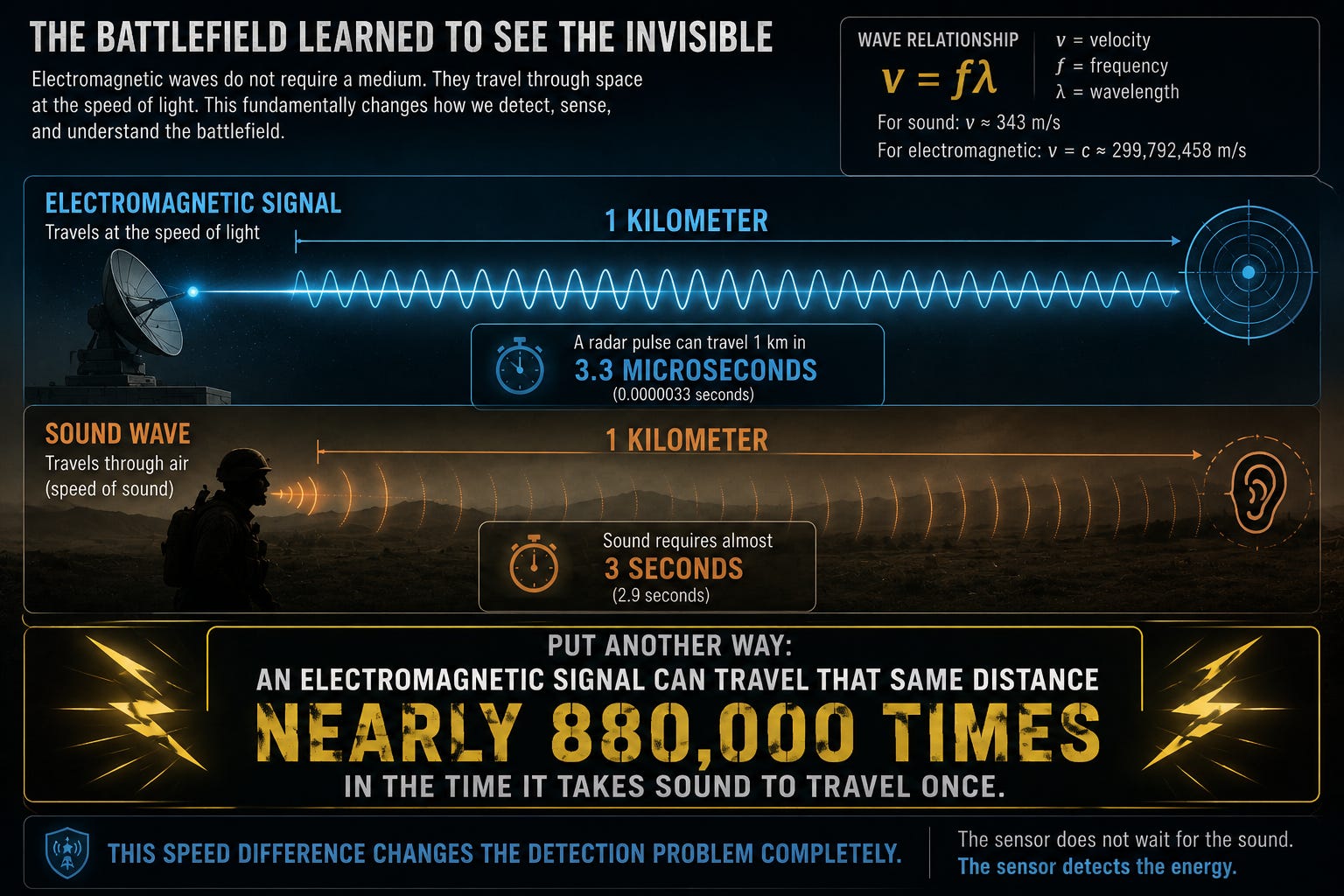
Unlike sound, electromagnetic waves do not require a physical medium to travel. They can propagate through the vacuum of space because they are not moving air molecules; they are oscillating electric and magnetic fields carrying energy from one location to another.
Electromagnetic waves travel at the speed of light:
299,792,458 meters per second
For most tactical distances, this means electromagnetic energy moves instantaneously compared to sound. A radio transmission, radar pulse, or satellite signal does not travel across the battlefield like a sound wave. It propagates.
The same relationship between velocity, frequency, and wavelength still applies:
v = fλ
However, instead of traveling at the speed of sound:
v = c
Where c = speed of light. The difference between these two speeds is enormous.
A radar pulse can travel one kilometer in approximately 3.3 microseconds. Sound requires almost three seconds to travel the same distance. Put another way, an electromagnetic signal can travel that same distance nearly 880,000 times in the time it takes sound to travel once. This speed difference changes the detection problem completely.
The Modern Battlefield Is an Electromagnetic Detection Problem
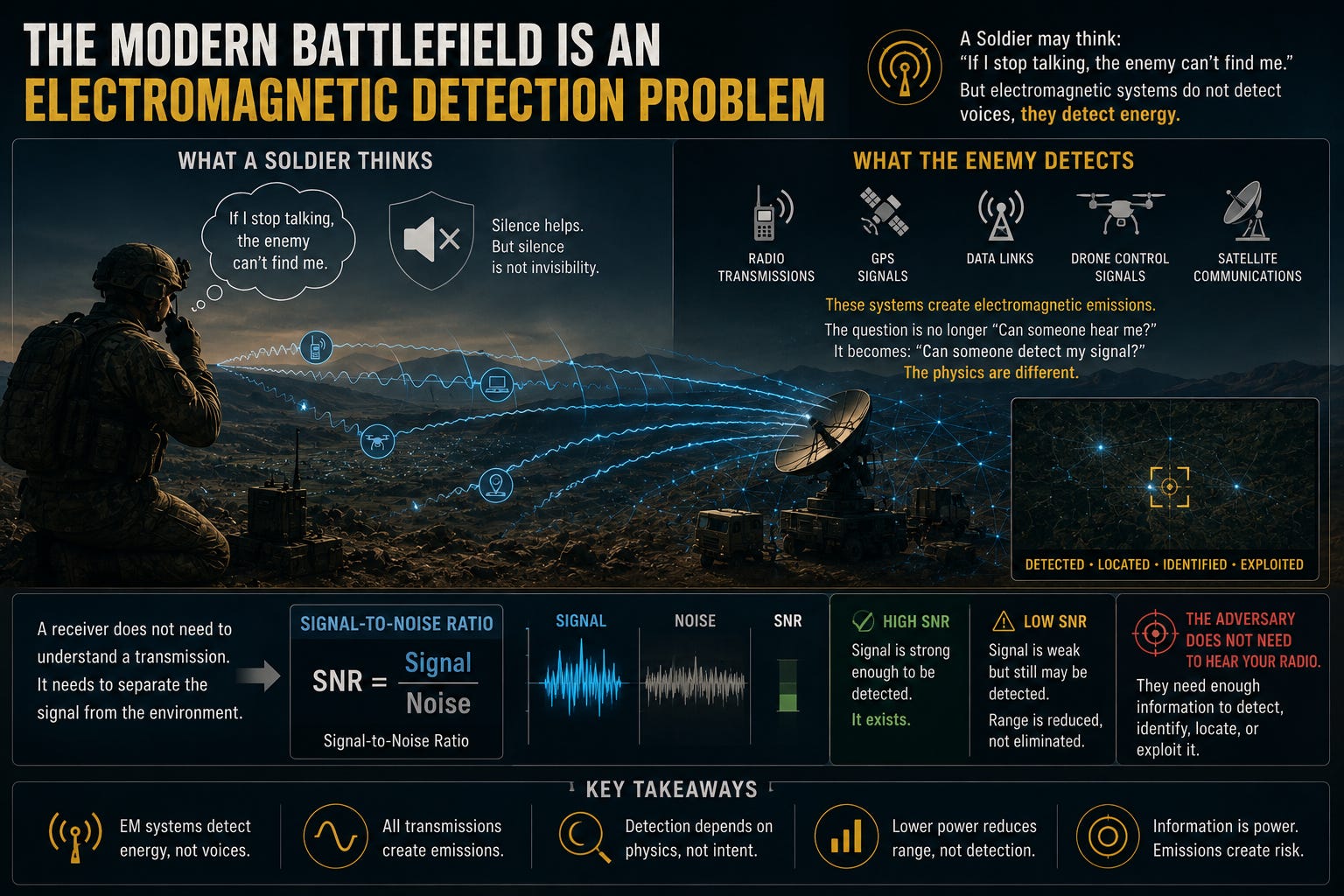
A Soldier may think: "If I stop talking, the enemy can’t find me." But electromagnetic systems do not detect voices, they detect energy.
A radio transmission, GPS signal, data link, drone control signal, or satellite communication creates electromagnetic emissions.
The question is no longer “Can someone hear me?", instead it becomes "Can someone detect my signal?" The physics are different.
A receiver does not need to understand a transmission. It needs to separate the signal from the environment. That relationship is described by the Signal-to-Noise Ratio:
SNR = Signal / Noise
If the signal is strong enough compared to the background noise, it exists. A low-power signal does not eliminate detection, it reduces range. The adversary does not need to hear your radio, they need enough information to detect, identify, locate, or exploit it.
From Sound Discipline to Energy Discipline
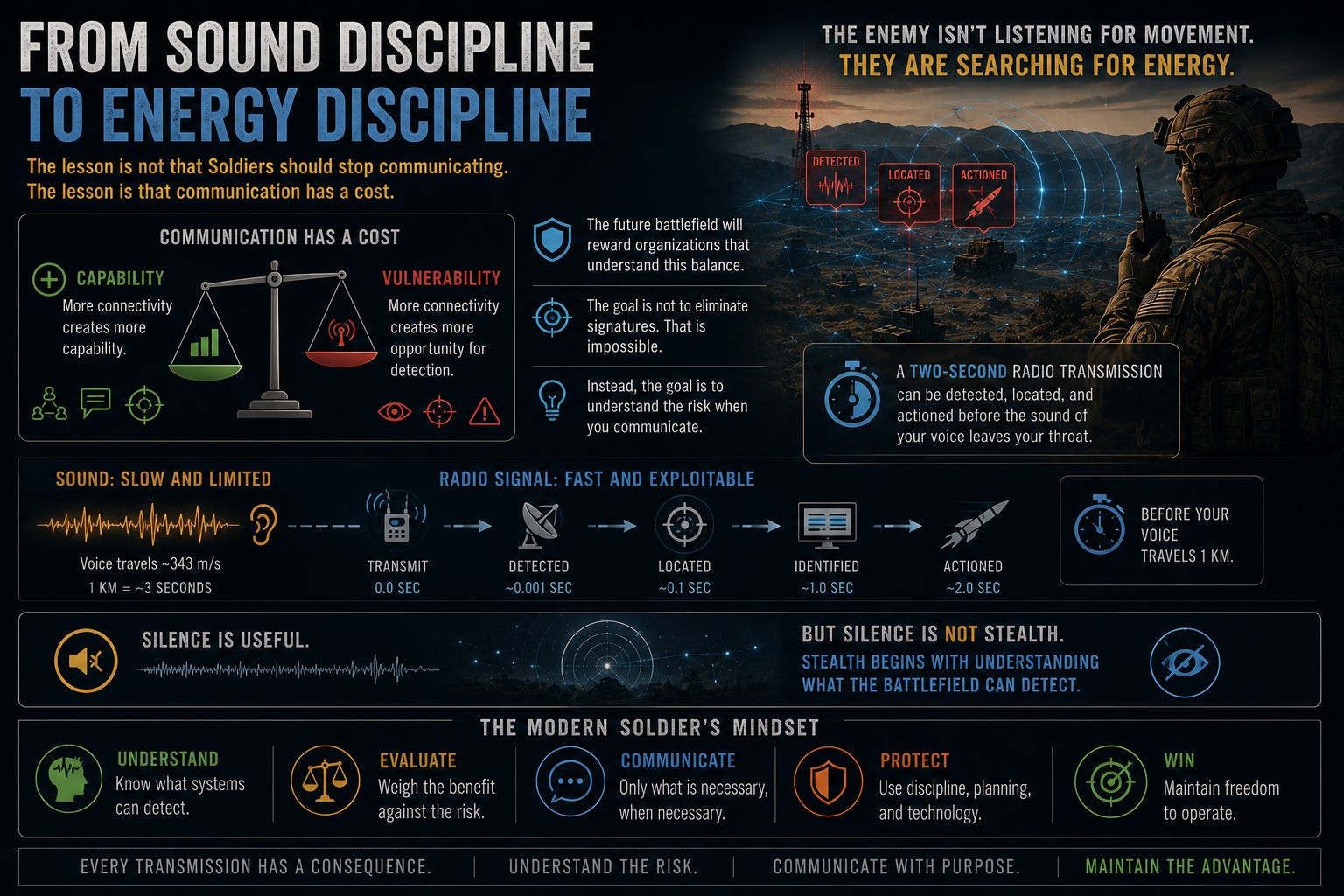
The lesson is not that Soldiers should stop communicating. The lesson is that communication has a cost.
Every transmission creates a relationship between capability and vulnerability. More connectivity creates more capability. But more connectivity also creates more opportunity for detection.
The future battlefield will reward organizations that understand this balance. The goal is not to eliminate signatures. That is impossible. Instead the goal is to understand the risk when a Soldier communicates.
The modern Soldier must recognize that the enemy is no longer listening for movement. They are searching for energy.
A two-second radio transmission can be detected, located, and actioned before the sound of a Soldiers voice leaves their throat. Silence is useful. But silence is not stealth.
Stealth begins with understanding what the battlefield can detect.
Over the next several articles, I’m going to document a project I’ve started building: a low-cost electromagnetic situational awareness system designed to help visualize the invisible environment around us.
The goal is simple: create a network of passive sensors that can observe electromagnetic activity, establish a baseline signature, and provide commanders and Soldiers a way to understand what the spectrum around them looks like. The end state is an iPhone/Android app that turns RF data into a common operating picture showing activity, changes, trends, and eventually patterns in the electromagnetic environment.
The steps I am going to follow are:
Buy a Raspberry Pi and set it up to run remotely (arrives today, 28JUN).
Learn basic Python to write simple programs that collect, store, and print data.
Connect a software-defined radio (SDR) and antenna to the Raspberry Pi so it can receive electromagnetic signals.
Process SDR data in Python by converting raw signal samples into usable features (such as frequency activity, signal strength, and time-based behavior).
Store collected measurements locally (initially on the device, later potentially in a structured database) so the system can track changes over time.
Build a basic backend service so other devices can request that data over a network.
Create a simple mobile app (iPhone/Android) that connects to that backend and displays the data in a readable format.
Deploy multiple sensor nodes to compare measurements across different physical locations and begin building spatial awareness of the environment.
Develop baseline models of “normal” electromagnetic activity to detect deviations and changes over time.
Refine the app so it becomes the main interface: a simple map and status view of electromagnetic activity across the area.
The challenge is not so much the passive detection, but 2 things, one; knowing/understanding what you detect (it is somewhat easy to decern a radio from GPS as an example), but understanding what type of radio takes working with the 2 shop. Two, a network of passive sensors need to communicate the detection and provide this data to a command cell to classify the target and add it to the targeting list.
That said - keep up this GREAT work! I am sharing your Substack with my old Soldiers and leaders to share with their subordinates tog et the word out as you make the complexities of EMS digestible. Which is not easy!
What you’re building sounds very much like this: <https://www.crowdsupply.com/scale-rf/quadrf#>