
PACE is Not a Checklist
Why military communications planning is a physics problem, not a procedural one

Every few weeks, someone asks a version of the same question:
“Why do we still plan for HF? Isn’t SATCOM reliable enough? Can’t we just rely on Upper Tactical Internet?”
Behind those questions sits a deeper misunderstanding, one that exists at every echelon of military formations. Many leaders treat a PACE plan (Primary, Alternate, Contingency, Emergency) as administrative overhead. A doctrinal checkbox. Something you brief because the checklist says to.
PACE is not about redundancy. It is a deliberate response to physics, geometry, and architectural dependency. It exists because electromagnetic energy behaves fundamentally differently across the spectrum and because no communications system survives every environment, every terrain profile, or every threat condition. Understanding why requires understanding what radios are actually doing when they transmit.
The Spectrum Dictates Capability and Vulnerability
All military communications ride the electromagnetic spectrum. Frequency determines how signals propagate, how much information they carry, and how they fail.
Higher frequencies offer larger bandwidth, higher data throughput, and greater precision. They are the fast lanes of the spectrum. But physics imposes steep costs: higher frequencies suffer greater free-space path loss, depend heavily on line-of-sight geometry, and are highly sensitive to obstruction and interference. The faster the lane, the more it demands a clear road.
Lower frequencies trade speed for reach. Longer wavelengths diffract around terrain, reflect off surfaces, and travel farther with less infrastructure. The road is slower, but it bends with the landscape.
PACE planning is, at its core, a strategy for distributing risk across different regions of that spectrum and different propagation mechanisms. Each layer of a PACE plan lives in a different part of the electromagnetic environment and fails in different ways.
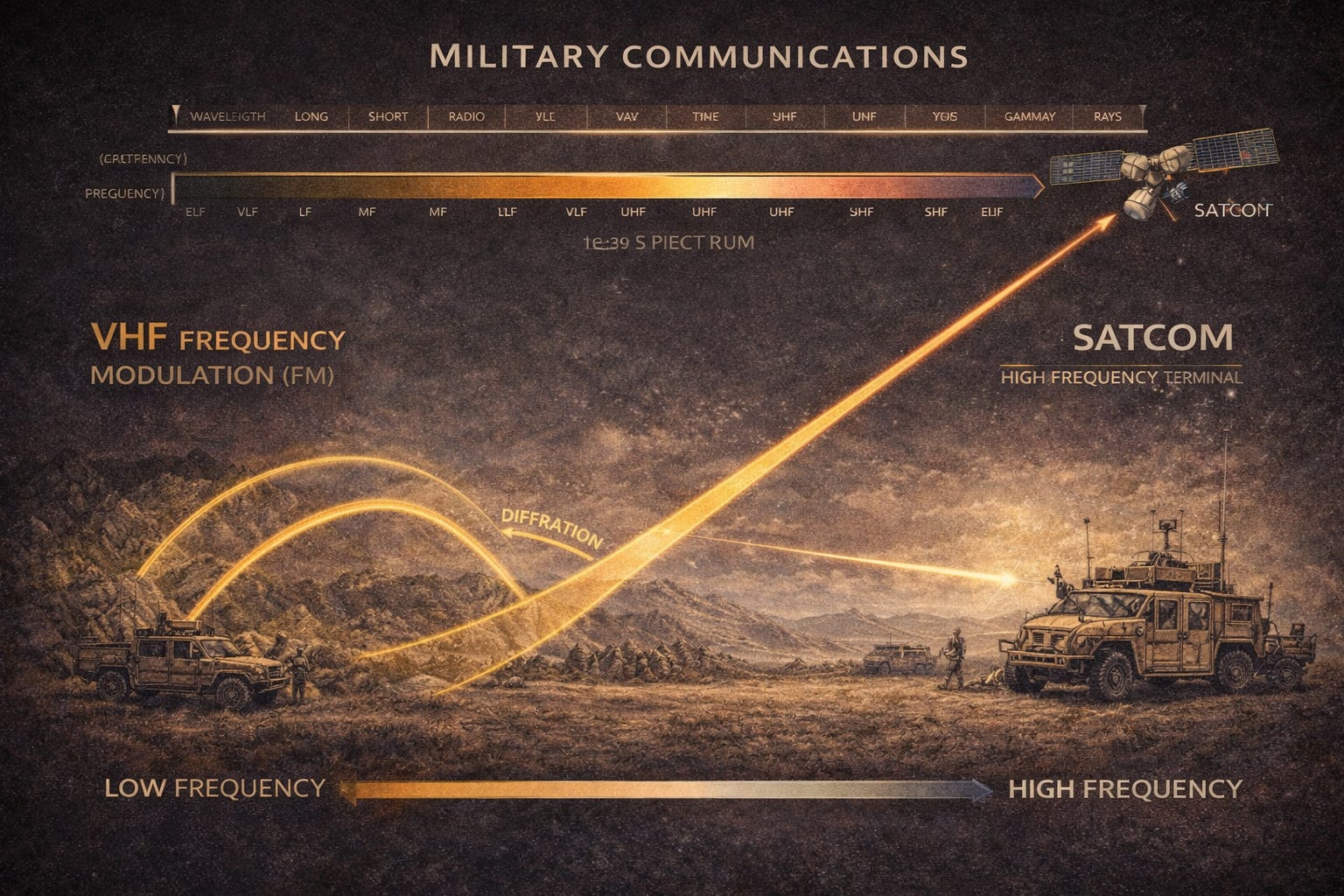
Primary: Upper Tactical Internet (UTI)
Upper Tactical Internet is typically selected as the Primary layer because it maximizes information flow across the formation. It enables mission command systems, common operational picture synchronization, large data transfers, and the networked integration of fires and sustainment. This is the architecture that delivers speed, visibility, and digital coordination at scale. Much of that capability, however, is enabled by SATCOM.
And this is where leaders often confuse reliability with invulnerability.
SATCOM links are extraordinarily reliable under normal conditions. They are engineered with generous link margins, robust error correction, adaptive modulation schemes, and high-gain antennas. In daily operations, SATCOM feels rock solid; stable, predictable, and dependable.
But reliability is not the same as resilience in a contested environment.
Why SATCOM is Architecturally Fragile
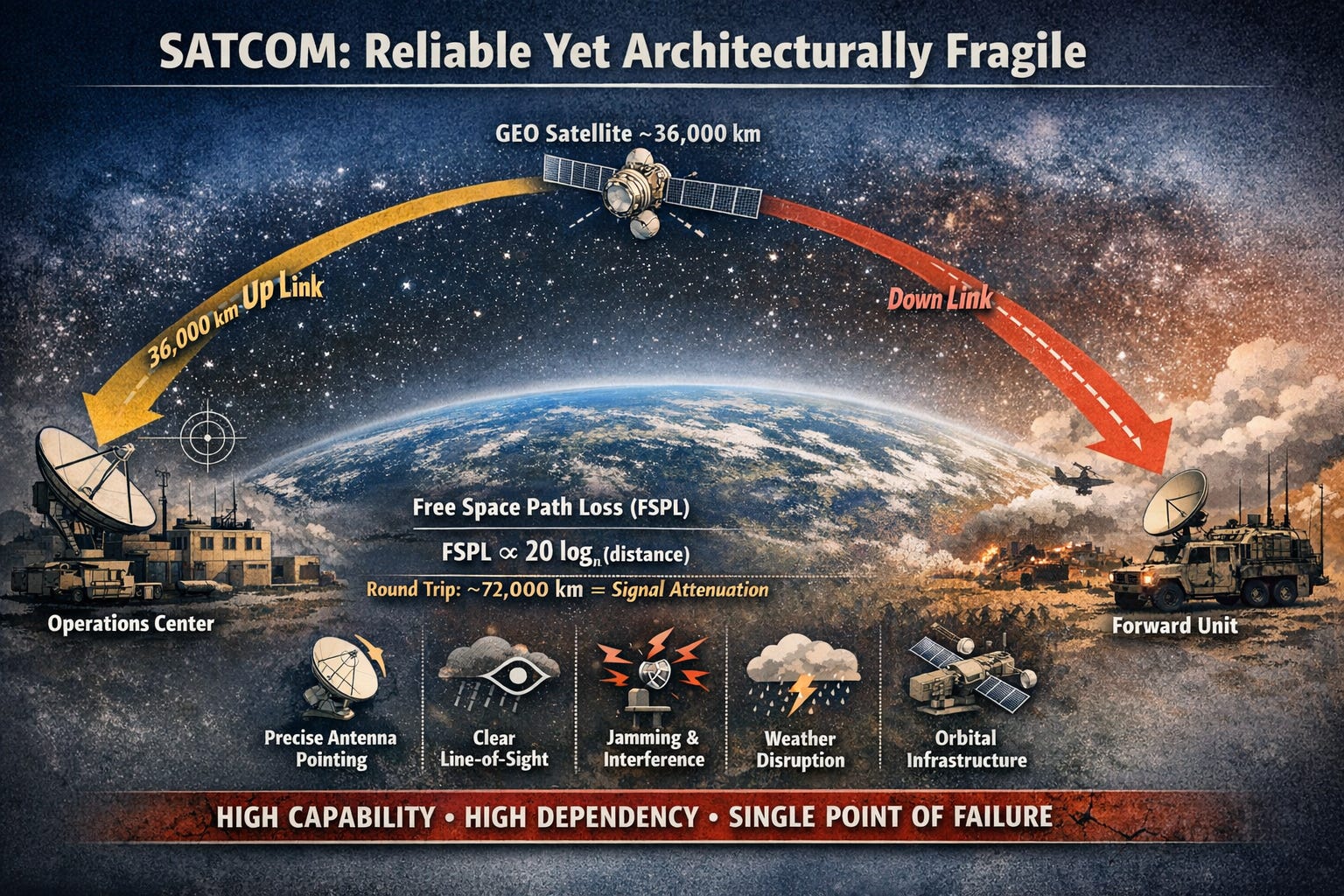
SATCOM introduces dependencies that terrestrial radios simply do not. A typical link must travel from a terminal to a satellite in geosynchronous orbit (roughly 36,000 kilometers above the Earth) and then back down to a ground station before reaching the network. That geometry imposes a significant physics penalty. Free Space Path Loss increases with distance, and a GEO round trip approaches 72,000 kilometers. Even with amplification, antenna gain, and advanced signal processing, the link is fundamentally fighting enormous attenuation.
These physics realities translate directly into operational constraints. SATCOM requires precise antenna pointing, a clear line-of-sight to space, and sufficient link margin to overcome interference. At higher frequency bands, performance becomes increasingly sensitive to atmospheric effects such as rain fade. All of this exists alongside a critical dependency on orbital infrastructure.
SATCOM is not fragile because it breaks easily. It is fragile because it concentrates extraordinary capability into a small number of essential dependencies. If access to space is denied, degraded, jammed, spoofed, or simply obstructed, Upper Tactical Internet performance can degrade rapidly.
High capability inevitably brings high dependency alongside distinct failure modes.
Alternate: Frequency Modulation (FM)
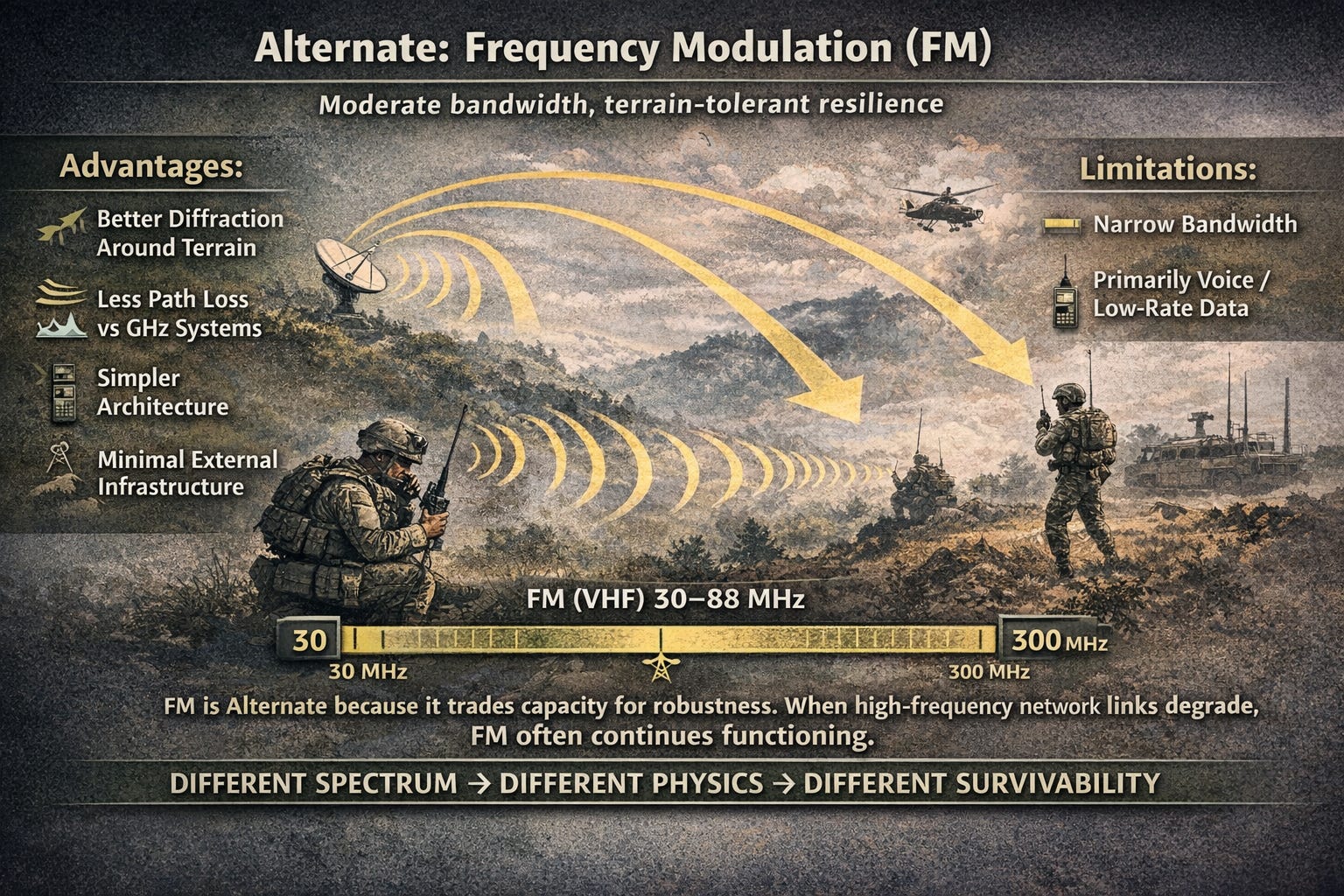
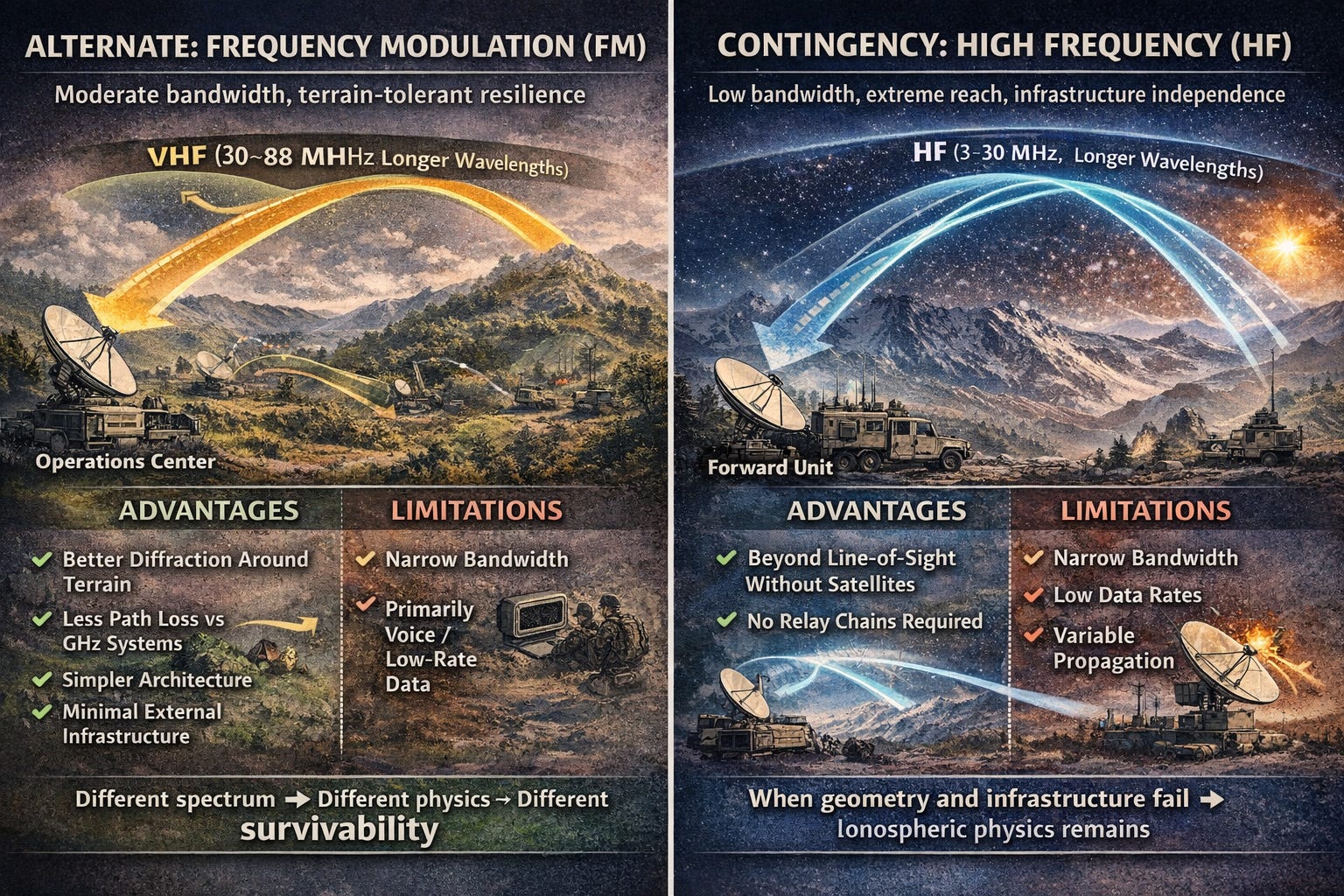
Frequency Modulation radios typically operate in the VHF band (roughly 30–88 MHz), a portion of the spectrum characterized by relatively low frequencies and correspondingly long wavelengths. At these frequencies, wavelengths measure several meters in length, and that physical property dramatically influences how the signal propagates through the environment.
Longer wavelengths interact with terrain differently than the short wavelengths used by higher-frequency systems. Rather than behaving like narrow beams that require clean line-of-sight paths, VHF signals tend to diffract, bending around terrain features, ridgelines, and urban structures. They also experience significantly less free space path loss compared to GHz-range systems over comparable distances. The result is a form of propagation that is inherently more tolerant of imperfect geometry, partial obstruction, and battlefield clutter.
FM systems also benefit from architectural simplicity. A typical VHF radio link requires no satellites, minimal network infrastructure, and relatively straightforward antenna configurations. This reduces dependency on external assets and eliminates several failure points that can affect more complex communication systems.
These strengths, however, come with clear limitations. VHF FM channels occupy relatively narrow bandwidths, which constrains data throughput. The systems excel at voice communications and low-rate data but cannot approach the capacity of SATCOM-enabled networks or high-frequency digital links. Information richness is sacrificed for stability.
FM is selected as the Alternate layer in a PACE plan precisely because of this trade-off. It does not compete with Upper Tactical Internet in bandwidth or speed, but it often survives conditions that degrade high-frequency systems. When line-of-sight links are masked, networks are disrupted, or SATCOM access becomes unreliable, FM frequently continues to function.
Different spectrum leads to different propagation physics, which in turn produces different survivability characteristics.
Contingency: High Frequency (HF)
High Frequency communications operate in the 3–30 MHz range, and signals in this portion of the spectrum behave in ways that are fundamentally different from both SATCOM and line-of-sight terrestrial systems. Unlike VHF links, which primarily depend on direct geometric paths between antennas, HF signals can use skywave propagation.
Instead of traveling strictly from transmitter to receiver along a line-of-sight path, an HF signal can be refracted by the ionosphere, a region of charged particles in the upper atmosphere created by solar radiation. Under the right conditions, energy transmitted upward returns to Earth far beyond the horizon:
Signal → Ionosphere → Refraction/Reflection → Receiver
This mechanism allows HF to achieve ranges measured in hundreds or even thousands of kilometers without satellites, relays, or terrestrial infrastructure. Mountains, curvature of the Earth, and destroyed retransmission nodes become far less relevant when the propagation medium is the atmosphere itself.
That independence is the defining strength of HF. It functions when:
• Satellites are denied or degraded
• Line-of-sight links are blocked by terrain
• Relay chains are disrupted
• Network infrastructure collapses
However, these advantages come with meaningful constraints. HF channels occupy narrow bandwidths, which limits data rates. Latency can be high. Most importantly, ionospheric propagation is inherently variable. Signal quality fluctuates with:
• Time of day
• Solar activity
• Frequency selection
• Atmospheric conditions
HF is therefore less predictable than FM and far less capable in throughput than UTI. It trades performance and stability for reach and independence.
This is precisely why HF sits in the Contingency layer of a PACE plan. It is not designed to replace high-bandwidth networks or provide seamless digital synchronization. It exists to survive scenarios that defeat both SATCOM-enabled systems and terrestrial line-of-sight radios.
When geometry fails and infrastructure disappears, ionospheric physics still remains.
Emergency: Joint Battle Command - Platform (JBC-P) or Mounted Mission Command Software (MMCS)
Emergency communication systems are built around a blunt, often uncomfortable assumption: real-time dominance may no longer be achievable. The network may be degraded, links may be intermittent, bandwidth may be constrained, and connectivity may appear only in brief, unpredictable windows. Under those conditions, the design priority shifts away from speed and toward persistence.
JBC-P, for example, typically rides the SATCOM layer as a default assumption. While SATCOM can be contested or degraded, JBC-P’s short, text-based messages are extremely efficient, allowing critical information to get through even when larger, higher-bandwidth systems like Upper TI or FM are struggling. Its resilience comes not from speed or throughput, but from the ability to deliver essential data under degraded, intermittent, or contested conditions.
The objective becomes message survivability rather than instantaneous exchange. Systems emphasize store-and-forward behavior, ensuring information is retained, retransmitted, and eventually delivered even when end-to-end connectivity does not exist at a single moment in time. Reliability is measured not in latency, but in whether critical data ultimately reaches its destination.
Emergency communications are not fast.
They are designed to be extremely difficult to kill completely.
Why the Military Distributes PACE Across These Systems
Notice the pattern:
UTI / SATCOM → High bandwidth → High dependency
FM → Moderate bandwidth → Lower dependency
HF → Low bandwidth → Minimal dependency
JBC-P → Minimal bandwidth, designed for degraded conditions
Each layer hedges against a different category of failure. UTI collapses under orbital denial or network disruption. FM survives those failures but struggles with severe terrain masking. HF survives terrain masking but is vulnerable to atmospheric variability and offers little throughput. JBC-P survives most of the above by demanding almost nothing from the network.
This is failure-mode diversification. Not redundancy. Redundancy means having multiple copies of the same thing. PACE means having fundamentally different things that fail for fundamentally different reasons.
The threat conditions that destroy one layer are often irrelevant to another. A jammer optimized against SATCOM frequencies has a completely different effect profile than terrain that blocks FM. Ionospheric propagation that makes HF unreliable has no effect on a JBC-P message waiting in a queue.
No single system dominates across all environments. The goal of PACE is to ensure that when high-bandwidth dominance collapses (as it will in a peer or near-peer conflict) lower-frequency persistence preserves the ability to command and control the force.
A Survivability Conversation
Leaders at every echelon are asking the right questions when they ask how their formation is communicating. Section to Platoon. Platoon to Battery. Battery to Battalion. Battalion to higher. These are not procedural conversations. They are survivability conversations.
A PACE plan that exists only on a briefing slide is not a PACE plan. It is a false sense of security. The test is not whether you can recite the four layers, it is whether every element of your formation has trained on each one and can transition between them under stress, with degraded equipment, in conditions they did not expect.
The adversary understands this. In any serious conflict, the high-bandwidth layer will be the first target. The question is not whether UTI will be contested. The question is how quickly your formation can fall to FM, and then to HF, and still maintain command and control.
That answer lives not in doctrine, but in rehearsal.
Technology evolves. Physics does not.
PACE planning is operational respect for that fact.