
How does cold affect the Electromagnetic Battlefield?
Extreme Temperatures, Atmospheric Physics, and the Hidden Fight for Electromagnetic Superiority

I’ve been thinking a lot about a recent article from Breaking Defense discussing how extreme cold affects the electromagnetic spectrum. Being stationed at Fort Drum, New York, I’ve already started noticing some of these effects firsthand, which pushed me to explore the topic further.
Article Referenced: https://breakingdefense.com/2026/05/first-of-its-kind-electromagnetic-spectrum-exercise-tests-senior-leaders-in-arctic-conditions/
Extreme cold, atmospheric instability, ionospheric turbulence, solar activity, ice crystals, temperature inversions, and shifting plasma densities all influence how electromagnetic energy propagates through the environment. Signals bend differently. Timing degrades. Radar behaves unpredictably. Communications fluctuate. Even the electronics themselves begin physically changing under thermal stress.
The result is that the Arctic does not simply challenge military operations physically, it reshapes the invisible electromagnetic environment modern military systems depend upon. Recent exercises focused on Arctic electromagnetic operations matter because the challenge is not merely surviving the cold; it is understanding how the environment alters sensing, navigation, communications, synchronization, and electronic warfare.
The Arctic is not just difficult terrain. It is a fundamentally different electromagnetic reality.
The Atmosphere Is Part of the Circuit
Most people imagine electromagnetic energy moving through empty space untouched by the world around it: a radio transmits, a receiver listens, the signal arrives. But that mental model is incomplete.
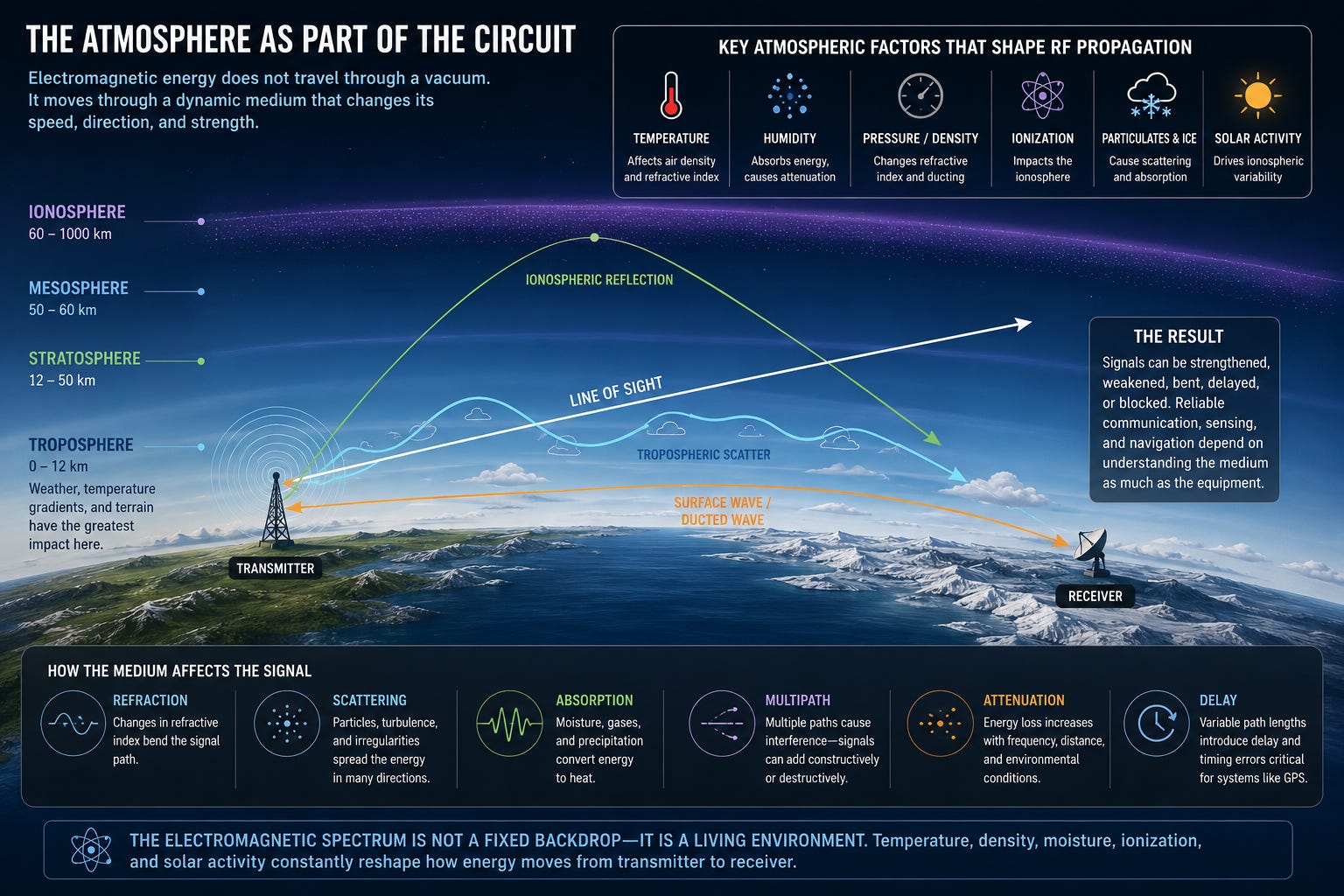
Electromagnetic energy does not move through a perfect vacuum once it reaches Earth. It moves through an active physical environment that constantly changes how the signal behaves. Temperature, humidity, pressure, ionization, precipitation, atmospheric density, and solar activity all influence how electromagnetic energy propagates. The atmosphere itself becomes part of the circuit.
That reality matters because military operations depend on electromagnetic energy behaving predictably. Radios, radar systems, GPS satellites, electronic warfare platforms, drones, data links, missile warning systems, and wireless networks all assume that signals can travel reliably from one point to another. But the environment is constantly reshaping those signals along the way.
At its most fundamental level, electromagnetic propagation is governed by the relationship between frequency, wavelength, and the speed of light: c = fλ. Frequency itself may remain constant, but how that wavelength interacts with the surrounding environment changes continuously. As electromagnetic energy moves through the atmosphere, refraction bends signals as atmospheric density changes with altitude and temperature; scattering spreads energy in multiple directions as particles, turbulence, and irregularities disrupt the wavefront; absorption converts portions of electromagnetic energy into heat through moisture, gases, and precipitation; multipath interference occurs when signals reflect off terrain, water, ice, or structures and arrive at slightly different times; and attenuation weakens signals over distance and through environmental resistance. None of these are software problems. They are physics problems.
This becomes especially important in extreme environments like the Arctic, where temperature gradients, ice crystals, ionospheric instability, and solar activity can dramatically alter propagation conditions. In those environments, the atmosphere stops behaving like a transparent medium and starts behaving like a dynamic electromagnetic terrain feature. Signals may travel farther than expected through atmospheric ducting. Radar beams may bend unpredictably. GPS timing may degrade as ionospheric disturbances distort satellite transmissions. Communications links that function perfectly in temperate climates may become unreliable in polar conditions. The electromagnetic spectrum is not a fixed backdrop behind modern technology. It is a living environment constantly shaped by physics.
Temperature Inversions and Atmospheric Ducting
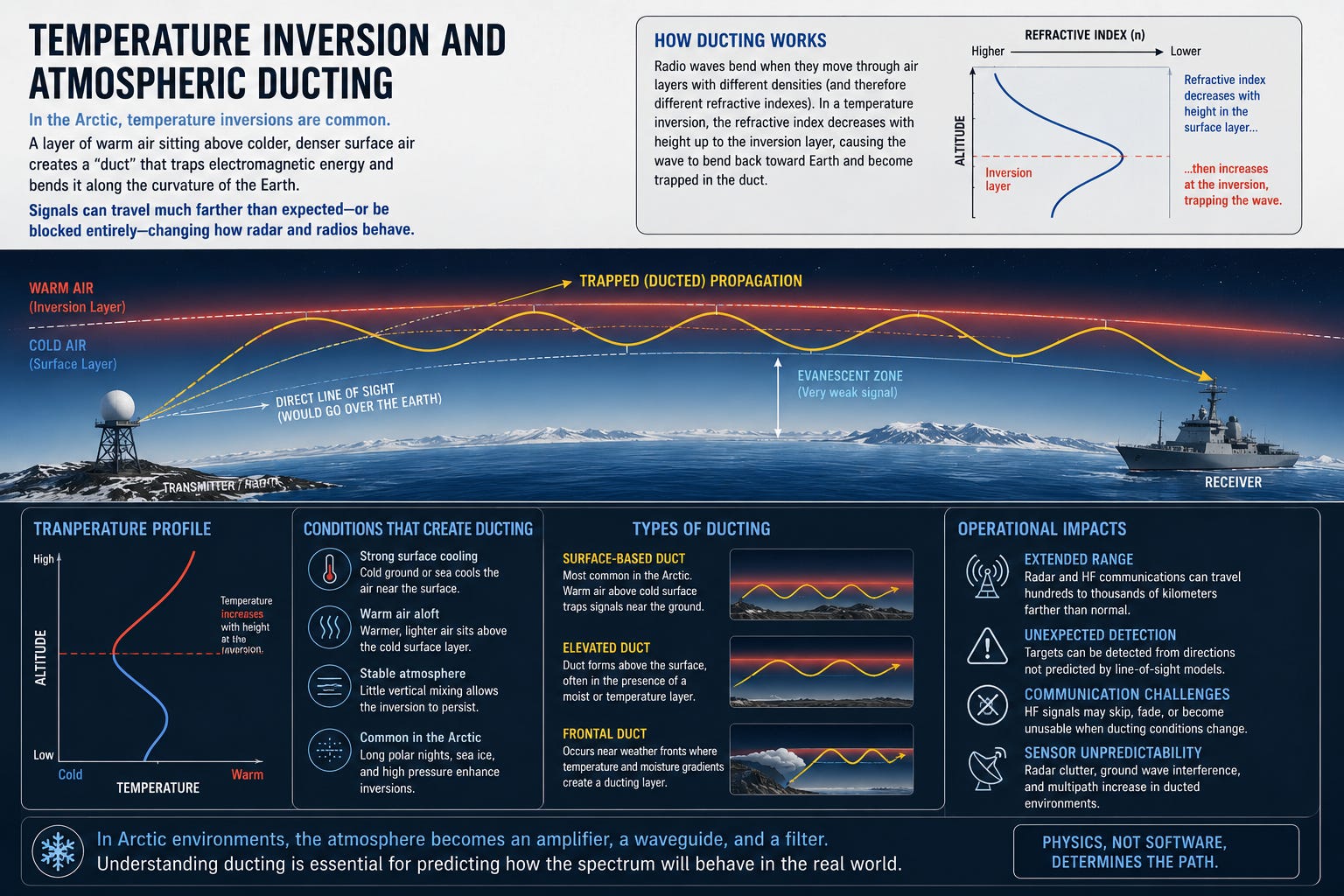
Under normal conditions, air temperature decreases with altitude. Warm air rises, cold air settles lower to the ground, and that predictable temperature gradient is what most communication systems, radar models, and propagation assumptions are designed around. But in extreme environments, the atmosphere often behaves differently.
Sometimes a layer of warmer air forms above a colder, denser surface layer; a phenomenon known as a temperature inversion. Instead of temperature decreasing with altitude, it temporarily increases, and that single change dramatically alters how electromagnetic energy moves through the atmosphere. The reason lies in the refractive index of air. As temperature, pressure, and density change, the atmosphere bends electromagnetic waves differently. Under inversion conditions, radio waves and radar energy can begin curving back toward the Earth instead of continuing outward into space. In certain conditions, the signal becomes trapped between atmospheric layers and the surface, forming what is known as an atmospheric duct. Rather than dispersing normally, electromagnetic energy begins traveling inside the duct almost like light moving through a fiber optic cable. The atmosphere itself becomes a waveguide.
This can produce effects that appear almost unnatural to operators expecting standard line-of-sight behavior. Signals may suddenly travel hundreds or even thousands of kilometers farther than expected. Radar systems may detect targets well beyond their anticipated range. Maritime vessels can appear on radar unexpectedly. Communications links may become unusually strong in one location while disappearing entirely in another. Then, just as quickly, the environment can change again.
Because ducting depends on precise atmospheric conditions, slight shifts in temperature, humidity, wind, or pressure can cause propagation paths to collapse or redirect entirely. Systems that worked moments earlier may suddenly fail. Sensors may experience clutter, false returns, fading, or dead zones. This becomes especially important in Arctic operations because the environment naturally supports persistent inversion layers. Sea ice, snow-covered terrain, long periods of darkness, stable high-pressure systems, and extremely cold surface temperatures all contribute to strong vertical temperature gradients. In polar regions, the atmosphere frequently becomes highly stratified, creating ideal conditions for ducting.
The result is an electromagnetic environment that behaves differently from the assumptions built into many traditional operational models. Radar coverage becomes less predictable. Electronic warfare effects may propagate farther than intended. Detection ranges fluctuate unexpectedly. Command-and-control networks become harder to stabilize. Signals intelligence systems encounter unusual propagation paths and reflections. In conventional thinking, terrain dominates maneuver. In electromagnetic operations, the atmosphere can become terrain itself. And in the Arctic, that terrain is constantly changing.
The Arctic Ionosphere Is Chaotic, Active, and Unpredictable
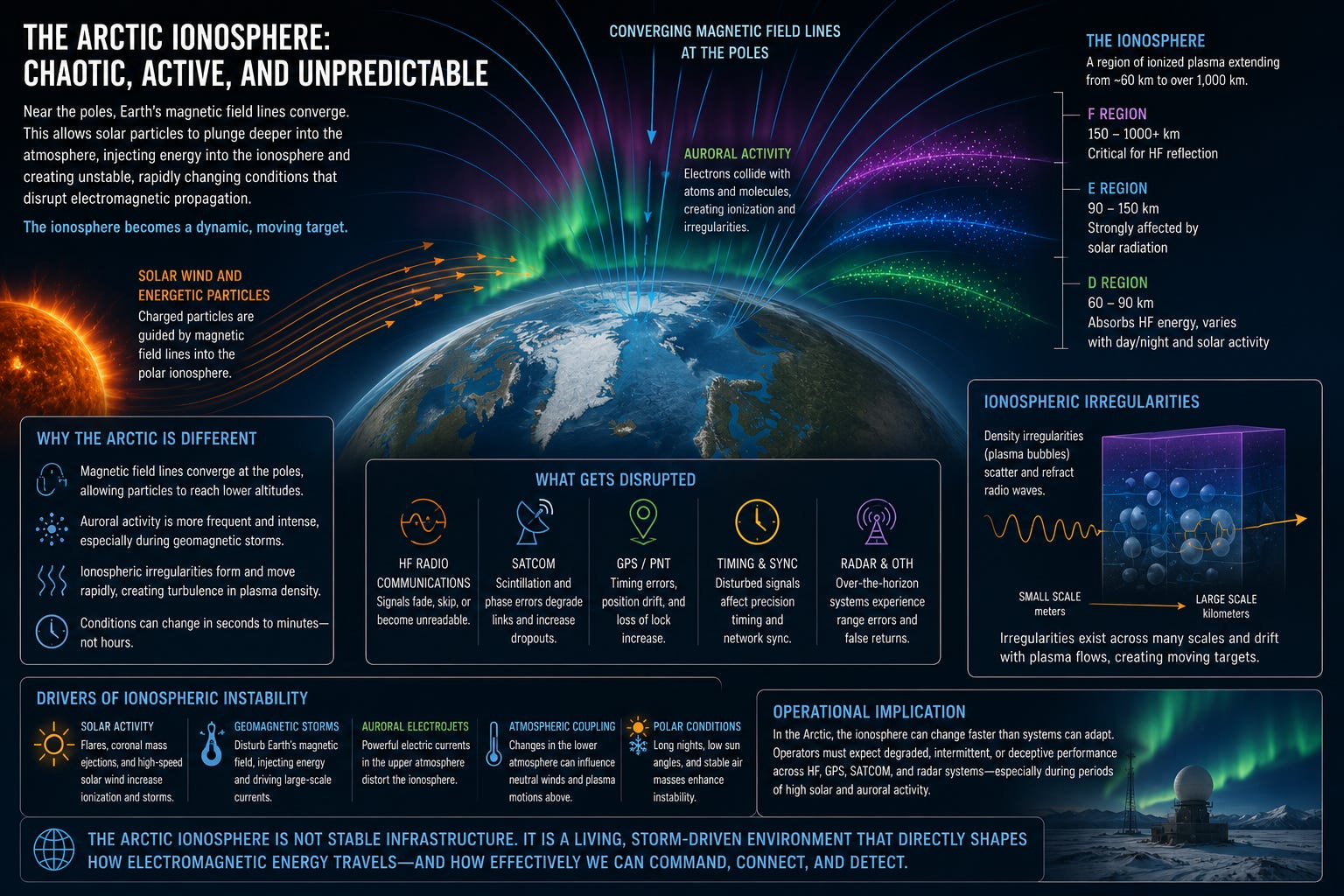
High above the Earth, beyond the weather systems of the lower atmosphere, lies another layer that quietly shapes the modern electromagnetic battlespace: the ionosphere. Stretching from roughly 60 kilometers to more than 1,000 kilometers above the Earth’s surface, the ionosphere is a region where solar radiation strips electrons away from atoms and molecules, creating a constantly shifting layer of electrically charged plasma.
This region plays a major role in how electromagnetic energy propagates across the planet. High-frequency radio signals can reflect off the ionosphere and travel beyond the horizon. Satellite communications must pass through it. GPS timing signals travel directly through it on their way to receivers on Earth. Radar systems interact with it. Long-range sensing systems depend on understanding it. And near the poles, the ionosphere becomes extraordinarily unstable.
The reason begins with Earth’s magnetic field. Magnetic field lines converge near the Arctic and Antarctic, creating pathways that allow charged solar particles to plunge deeper into the upper atmosphere. As streams of energetic particles from the Sun collide with the ionosphere, they inject energy directly into the plasma environment. The visible result is the aurora (northern lights).
As solar energy enters the polar ionosphere, plasma density begins fluctuating rapidly. Irregular structures form and drift through the atmosphere. Electron concentrations rise and collapse. Turbulence develops across multiple scales, from meters to hundreds of kilometers. The ionosphere becomes a moving target. Unlike terrain, which changes slowly, ionospheric conditions can evolve in seconds or minutes. A communication path that exists one moment may disappear the next. GPS accuracy may suddenly degrade. Radar performance may shift unexpectedly. Satellite links may fade or drop entirely. In many cases, the systems themselves are functioning perfectly. The environment around them is not.
This creates major challenges for electromagnetic operations in Arctic regions. High-frequency radio communications often become inconsistent because ionospheric reflection conditions continuously change. Satellite communications can experience phase distortion and signal fading as radio waves pass through turbulent plasma regions. GPS receivers may encounter scintillation effects that introduce timing errors, positional drift, or complete signal loss.
That matters because modern military systems are fundamentally dependent on precise timing and synchronization; for example navigation systems, precision-guided weapons, networked fires, sensor fusion, data links, and command-and-control architectures all depend on electromagnetic timing signals arriving exactly when expected. Even tiny disruptions can ripple across an entire operational system. The Arctic compounds these challenges because the polar ionosphere experiences stronger interactions with solar activity than lower latitudes. During periods of elevated solar activity, electromagnetic conditions can deteriorate rapidly across enormous geographic areas.
In effect, the Arctic ionosphere behaves less like stable infrastructure and more like a constantly evolving weather system made of plasma and electromagnetic energy. And unlike storms on the ground, these disturbances are often invisible to the operators depending on the systems being affected. That creates one of the central realities of Arctic electromagnetic operations: the environment itself becomes an active participant in the fight; not because it is hostile in the traditional sense, but because the physics governing electromagnetic propagation are continuously changing faster than many systems are designed to adapt.
GPS Signals Become Fragile in Polar Regions
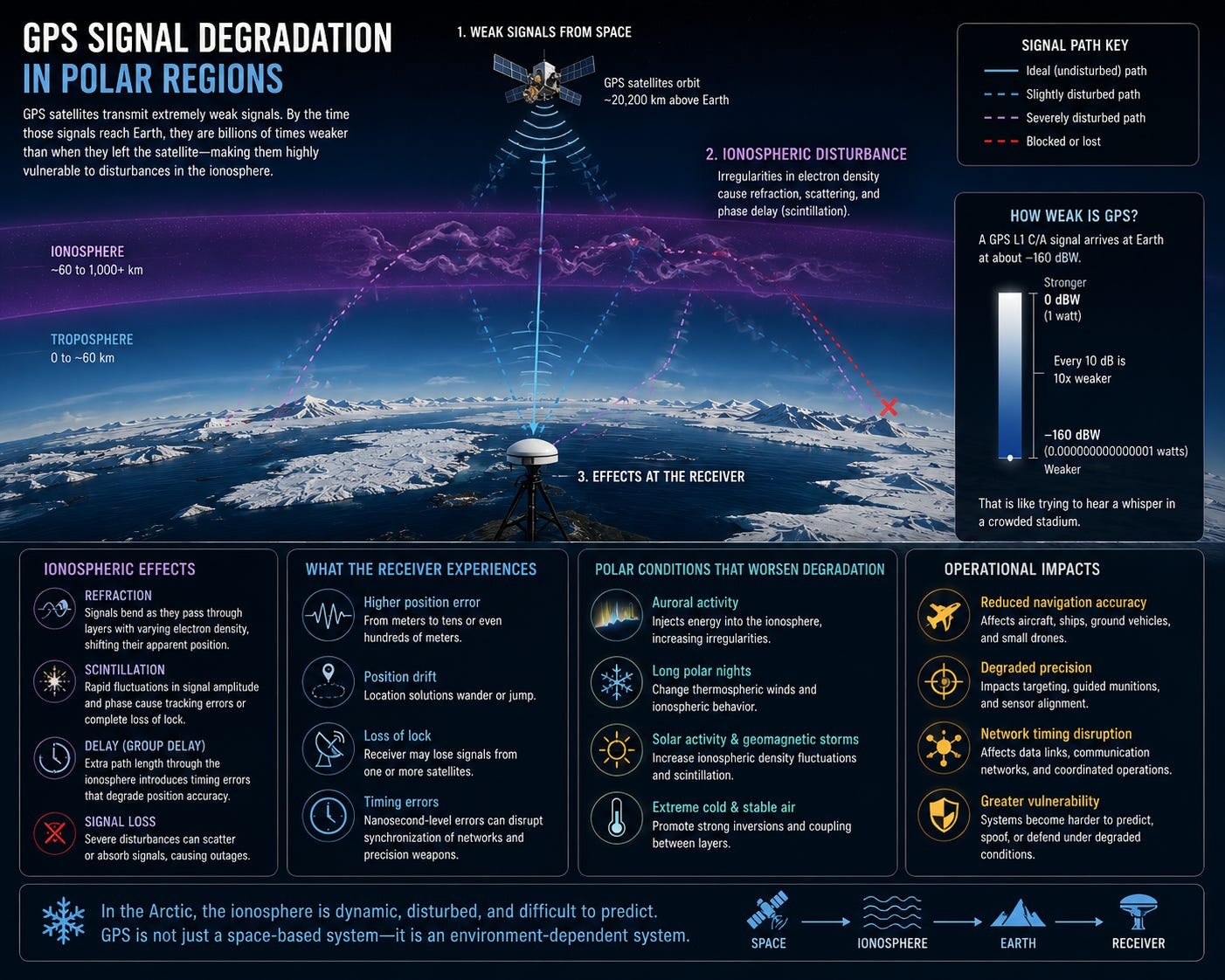
Most people think of GPS as a navigation system. In reality, it is a timing system that happens to provide navigation. Every GPS receiver works by measuring the arrival time of electromagnetic signals transmitted from satellites orbiting roughly 20,200 kilometers above the Earth. By comparing timing differences between multiple satellites, the receiver calculates its position in space. That process depends on one critical assumption: the signals must arrive exactly when expected.
Even tiny timing errors matter. Because electromagnetic energy travels at the speed of light, a timing error of just one nanosecond can translate into position errors measured in feet. Larger disruptions quickly expand into tens, hundreds, or even thousands of meters of uncertainty. And GPS signals are extraordinarily weak by the time they reach Earth; often weaker than background thermal noise. Receivers recover the signal through advanced correlation techniques, signal integration, and precise synchronization. In practical terms, GPS works because the receiver is exceptionally good at detecting faint patterns buried inside noise. That makes the system incredibly sensitive to environmental disturbances.
Before reaching a receiver, GPS signals must travel through the ionosphere; the same unstable plasma environment already being reshaped by solar activity, geomagnetic storms, auroral processes, and polar magnetic field interactions. As the signal passes through irregular plasma regions, the signal path bends due to changes in electron density, portions of the wave scatter unpredictably, signal phase shifts occur, and small-scale plasma turbulence creates rapid fluctuations in signal amplitude and timing, a phenomenon known as scintillation. The receiver begins struggling to maintain synchronization. Under severe conditions, it may temporarily lose lock on one or more satellites entirely.
Near the Arctic, the ionosphere is far more dynamic and unstable than at lower latitudes. Auroral activity injects energy directly into the plasma environment. Geomagnetic storms intensify density irregularities. Long polar nights alter upper-atmospheric circulation patterns. The entire propagation environment becomes more turbulent and less predictable. Position estimates drift, timing precision deteriorates, navigation solutions become unstable, data links lose synchronization, and precision systems accumulate error.
And because modern military systems are deeply interconnected, these effects rarely remain isolated. Precision-guided weapons rely on accurate timing and positioning. Networked fires depend on synchronized clocks. Aircraft navigation systems require stable satellite solutions. ISR platforms align sensor data using precise timing references. Communication networks depend on coordinated timing across distributed nodes. When GPS performance degrades, entire operational architectures begin experiencing friction. Importantly, many of these disruptions do not look dramatic, there is often no obvious system failure, no explosion, no visible attack. Instead, the system simply becomes slightly less precise, then less stable, then less trustworthy. In highly synchronized operations, even small timing instability can create cascading effects across a force. This is what makes Arctic electromagnetic operations uniquely difficult.
Extreme Cold Changes the Hardware Itself
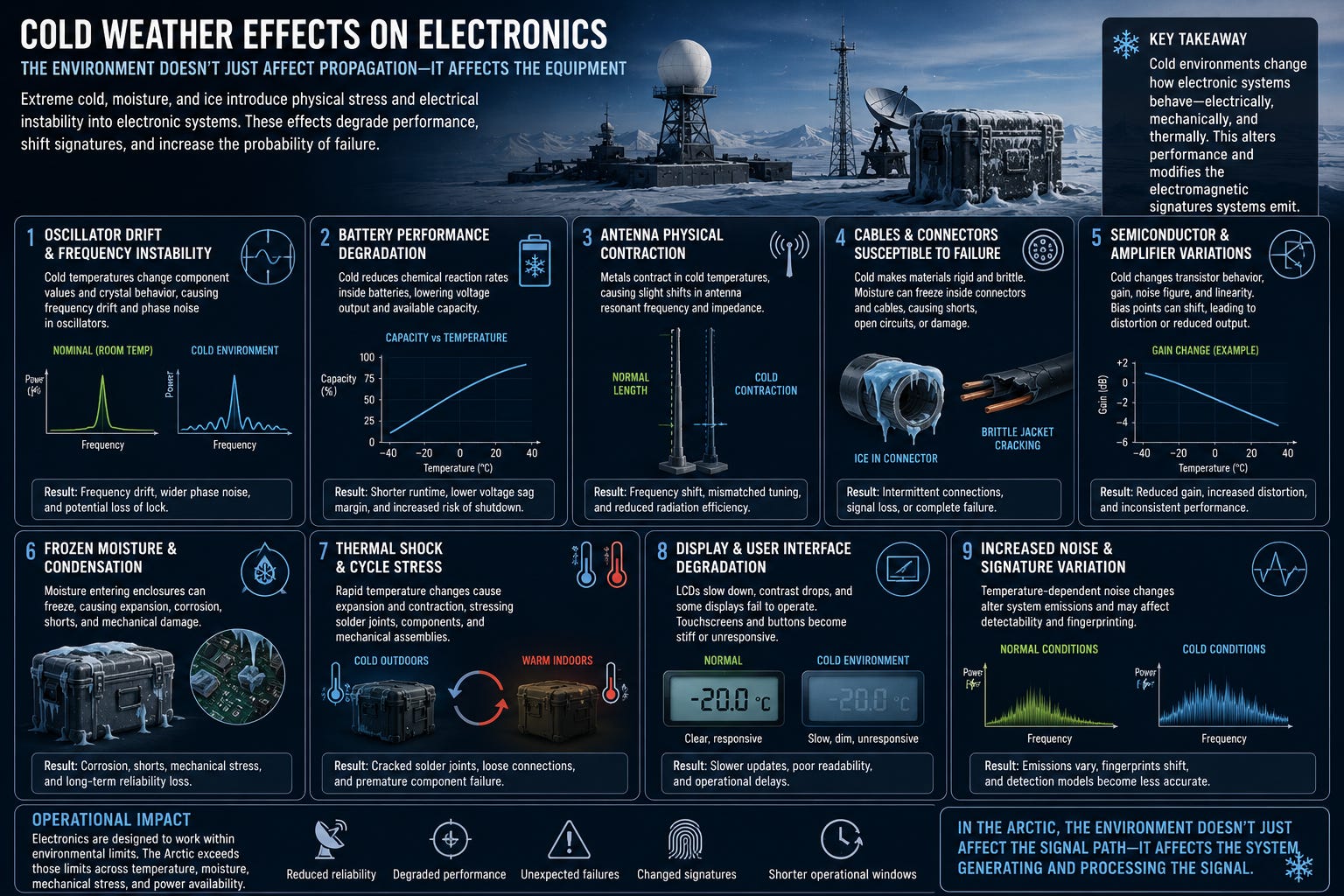
The electromagnetic environment is not the only thing altered by Arctic conditions. The hardware generating, receiving, processing, and amplifying electromagnetic energy changes as well. This is an important distinction because electromagnetic systems are often discussed as if they operate independently from their physical construction. In reality, every radio, radar, satellite terminal, antenna, amplifier, oscillator, cable, and receiver is still a physical object governed by thermodynamics, material science, and electrical engineering. Extreme cold changes those systems at nearly every level.
Some of the effects are obvious. Batteries lose efficiency as chemical reactions slow in low temperatures. Lubricants thicken. Mechanical components become brittle. Ice accumulates on antennas and radar domes. Connectors contract. Cabling stiffens. Condensation forms during thermal cycling and later freezes. But many of the most important effects occur invisibly inside the electronics themselves.
Oscillators begin drifting. This matters because oscillators provide the timing reference for nearly every electromagnetic system. Radios depend on them to generate stable carrier frequencies. Receivers depend on them for synchronization. Radar systems rely on precise timing relationships. Digital networks use them to coordinate data transmission and processing. Even small temperature-induced instability can ripple throughout an entire system. As components cool, their electrical properties shift slightly; materials contract microscopically, resonant frequencies move, crystal oscillators experience frequency drift, amplifier behavior changes, and filters no longer respond exactly as designed. Timing relationships begin accumulating small errors.
Individually, these deviations may appear insignificant. Collectively, they can alter how a system behaves electromagnetically. A transmitter may radiate slightly outside its intended frequency. A receiver may lose sensitivity. Noise floors may rise. Phase stability may degrade. Signal quality may fluctuate. Synchronization margins may narrow. In harsh Arctic conditions, systems are often operating closer to their physical limits than designers originally anticipated.
This becomes especially important in modern digitally networked systems where precision matters enormously. Digital communications depend on timing accuracy. Beamforming systems depend on phase alignment. Electronic warfare systems depend on precise signal characterization. Radar systems depend on coherent timing relationships. Software-defined radios depend on stable frequency references. When environmental stress begins affecting timing and stability, the electromagnetic behavior of the system itself starts changing.
In some cases, this can even alter the electromagnetic “fingerprint” of a device. No transmitter is perfectly identical to another; tiny manufacturing variations already create subtle differences in emitted signals through small imperfections in oscillators, nonlinearities in amplifiers, timing variations, harmonic distortion, and phase noise. Extreme cold can amplify or modify those characteristics. An emitter operating in Arctic conditions may drift differently than the same system operating in temperate environments. From a signals intelligence perspective, the environment itself can influence how identifiable an emitter becomes. The Arctic therefore creates a dual electromagnetic challenge: the atmosphere changes how signals propagate, while the cold changes the systems generating the signals in the first place.
The Spectrum Becomes Congested, Contested, and Unpredictable
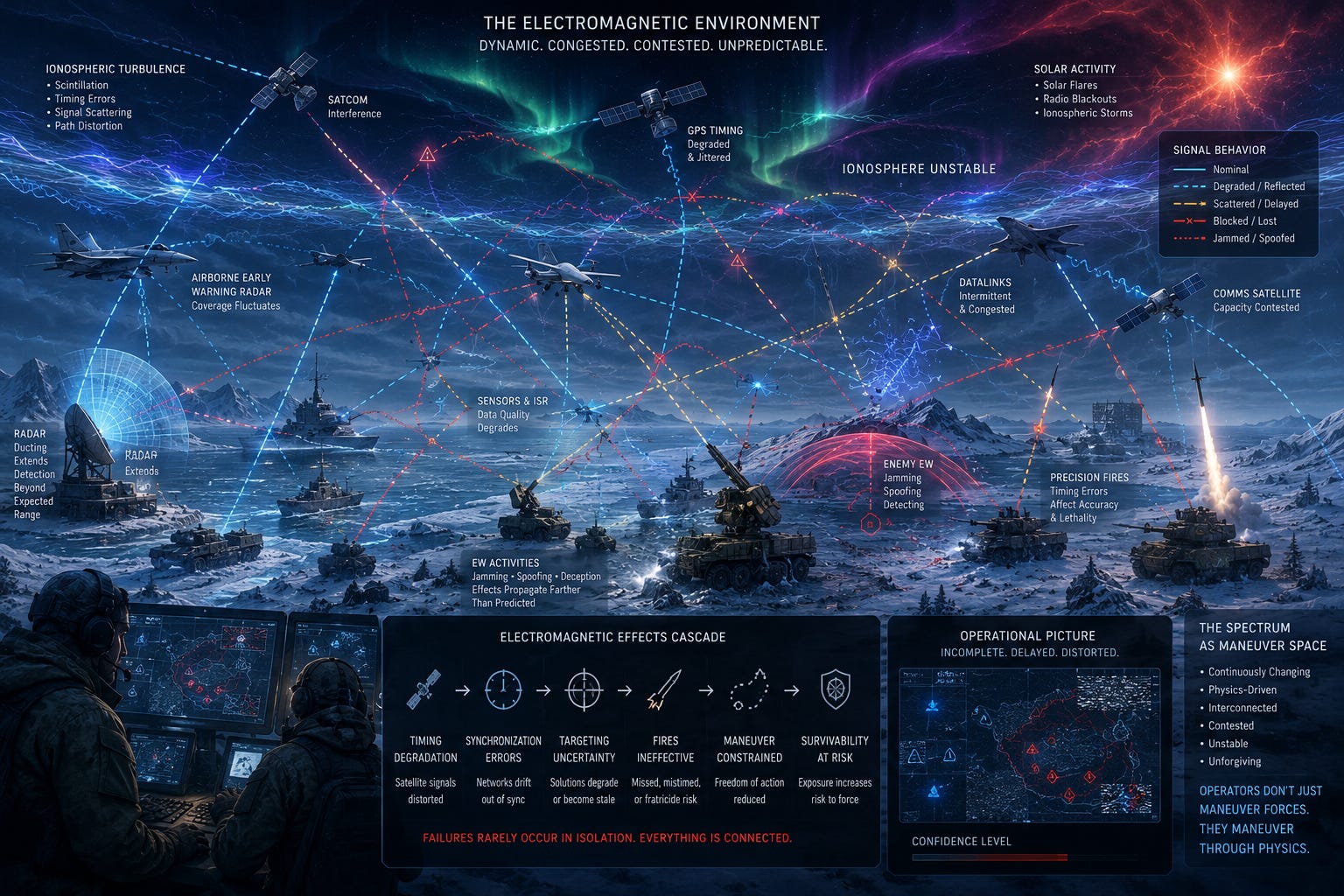
Modern military operations are built on the assumption that electromagnetic connectivity exists; not just communications, but connectivity itself. Aircraft navigate using satellite timing. Radars search electronically across vast distances. Drones rely on data links and remote control signals. Precision-guided weapons depend on synchronized positioning. Command-and-control systems distribute information across wireless networks. Sensors feed targeting data into digital architectures. Electronic warfare systems search for, classify, and disrupt signals continuously. Even systems that appear independent are often connected through hidden electromagnetic dependencies. The electromagnetic spectrum is no longer merely supporting military operations. It is enabling them.
That dependence creates a major vulnerability in extreme environments like the Arctic because the electromagnetic environment itself becomes unstable at the exact moment military systems become more dependent on it. Signals already weakened by distance begin interacting with unstable atmospheric layers. Ionospheric turbulence distorts timing and synchronization. Cold weather alters the performance of the systems generating the signals. Propagation paths fluctuate unpredictably. Radar coverage changes dynamically. GPS timing becomes less reliable. At the same time, military forces continue adding more electromagnetic activity into the environment; more sensors, more radios, more satellites, more datalinks, more autonomous systems, more emitters competing for spectrum access simultaneously. The result is not simply congestion. It is electromagnetic complexity.
Every transmission becomes part of an increasingly dense and dynamic environment where systems are simultaneously transmitting, receiving, sensing, synchronizing, locating, classifying, interfering, and adapting; all while the atmosphere itself continues changing the behavior of the signals moving through it. In stable environments, many of these systems can compensate for minor disruptions automatically. In Arctic conditions, the environment may change faster than the adaptation cycle itself.
A communications path that worked minutes ago may suddenly fail due to shifting ionospheric conditions. A radar contact may appear beyond expected range because of atmospheric ducting. GPS timing may drift enough to disrupt synchronization across a network. Electronic warfare effects may propagate farther than predicted. Autonomous systems may encounter intermittent control links. The operational picture becomes less stable. And critically, these failures rarely occur in isolation. Modern military systems are deeply interconnected: a timing error affects synchronization, synchronization affects targeting, targeting affects fires, fires affect maneuver, maneuver affects survivability. The spectrum quietly links everything together.
This is one of the reasons military organizations are increasingly treating the electromagnetic spectrum as maneuver space rather than merely technical infrastructure. Unlike physical terrain, electromagnetic terrain changes continuously; the atmosphere shifts, the ionosphere fluctuates, solar activity intensifies, signals interfere, hardware drifts, networks adapt, and adversaries jam, spoof, detect, and classify. The environment never truly stabilizes. In the Arctic, this becomes especially important because operators are often forced to make decisions in conditions where the electromagnetic picture itself may be incomplete, delayed, distorted, or temporarily misleading. This changes the nature of command. Leaders are no longer simply maneuvering forces across geography. They are maneuvering through physics.
Why the Arctic Matters Strategically
For most of modern history, the Arctic was viewed primarily as a geographic obstacle; remote, frozen, difficult to access, and operationally punishing. But as technology advanced, the Arctic became something else: a strategic electromagnetic corridor. The shortest routes between major global powers pass across the polar regions. Long-range aviation routes cross the Arctic. Missile trajectories travel over the poles. Polar-orbiting satellites repeatedly pass through Arctic space. Early warning radars monitor northern approaches. Submarines maneuver beneath polar ice. Communications systems stretch across enormous distances where infrastructure remains sparse and environmental conditions remain extreme. The Arctic is no longer peripheral. It is becoming central to how modern military powers sense, communicate, deter, and project force globally.
That reality is driving increased military focus on Arctic electromagnetic operations. Russia has invested heavily in Arctic infrastructure, radar systems, air defense networks, electronic warfare capabilities, and northern military basing. China increasingly describes itself as a “near-Arctic state” while expanding interest in polar shipping routes, communications architecture, and scientific access. NATO forces are conducting larger exercises in northern environments while attempting to better understand how operations change in extreme electromagnetic conditions. The strategic competition is not only about territory. It is about access to information and the ability to operate reliably inside one of the harshest electromagnetic environments on Earth.
Modern military power depends heavily on the ability to maintain awareness, synchronization, and connectivity across distributed systems. The force that can best sense, communicate, navigate, synchronize, and adapt inside degraded electromagnetic conditions gains enormous operational advantage. And the Arctic naturally degrades all of those things. Distance weakens signals, ionospheric instability distorts propagation, extreme cold stresses electronics, sparse infrastructure limits redundancy, atmospheric conditions fluctuate rapidly, and solar activity disrupts timing and communications. The environment itself becomes a persistent source of uncertainty.
This is why recent Arctic-focused electromagnetic exercises are so important. They are forcing military leaders to confront an uncomfortable reality: many systems designed for stable electromagnetic conditions may behave very differently in the Arctic. A force can possess advanced satellites, powerful radars, precision weapons, sophisticated networks, and cutting-edge electronic warfare systems and still struggle if it cannot understand how the environment is reshaping the electromagnetic conditions those systems depend upon. The future electromagnetic fight may not belong solely to the side with the most technology. It may belong to the side that best understands the physics governing the environment where that technology operates.
What kind of sensing or information gear would you want to have at the brigade or company level to improve EMS SA?